Born Again Christians Just as Likely to Divorce as Are Non-christians
Many pastors and pundits claim that divorce rates between Christians and non-Christians are the same. But this statistic is misleading at all-time and grossly understates the bodily connectedness between organized religion and marriage. For nearly 50 years, people who attend church regularly marry at much higher rates and, for a majority of the population, those who attend church ofttimes as well divorce at lower rates than the rest of the population.
Both marriage and church omnipresence accept been in decline in the United states of america since 1970. During this time, fertility rates have fallen and rates of cohabitation have increased. Each tendency represents large changes in family formation, and the impact on social club is still non fully understood. The decline of both organized religion and spousal relationship take received a lot of individual attention past researchers, but are unremarkably analyzed separately. What if these two trends are connected in some fashion?
Historically, Christianity has encouraged adherents to ally and mostly discourages divorce. It seems strange to think that these behavior would have zero impact on marital choices fabricated by believers. It makes sense that the impact of these beliefs would be greater amid those who are the most active in practicing their faith. Indeed, there is strong prove connecting regular church omnipresence with higher human relationship quality for Latinos and Blacks and for Americans in full general.
When trying to sympathise how much people value something, economists pay particular attention to the value of what people surrender in order to judge how much they value what they get in exchange. Coin is a common metric for value, but time is another metric that is sometimes easier to use. When it comes to Christianity, people are often reluctant to hash out how much money they contribute to their churches but are more forthcoming when asked how much time they spend on religious activities. Economists who report religion often utilise the frequency of church omnipresence as a proxy for the force of an individual'due south religious beliefs.
Using this line of reasoning, we can divide the American population into two groups: i) the "devout," or those who attend church two to iii times a month or more; and 2) the "non-devout," or those who attend church once a month or less. The following assay used information for people ages 25 to 54 from the General Social Survey (GSS).1
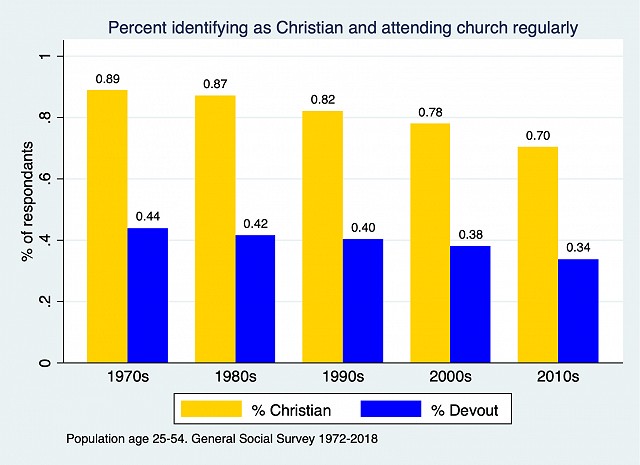
Looking at how people identify themselves religiously across fourth dimension allows for several interesting observations. Start, the percentage of individuals identifying as Christian has declined from 89% in the 1970s to 70% of the population today. Second, the per centum who nourish church two to 3 times per month or more is roughly one-half of those who identify as Christian across all decades. 3rd, a majority of the population identifies every bit Christian, which may explain why the divorce rates of this group may not differ much from the national average. Fourth, the "devout" represent a minority of the population, and their divorce and marriage rates may be significantly different.
To examine these observations, we can expect at how marriage and divorce compare between Americans who attend church relative to those who do not.
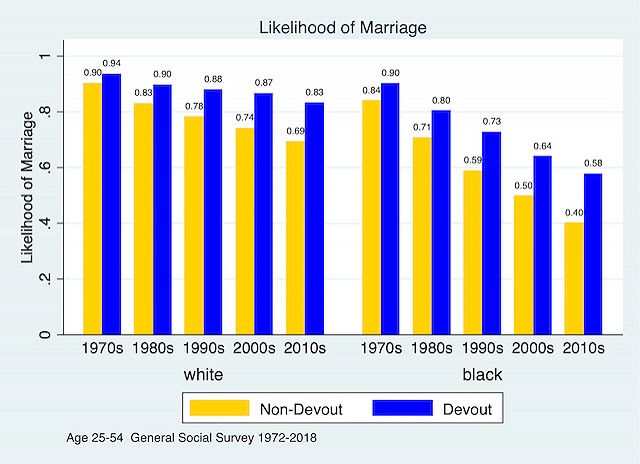
Here, it is articulate that marriage rates have been falling for the population as a whole. But those who attend church on a regular basis are significantly more probable to marry than their less devout peers. Breaking this assay down further past race,2 we see higher rates of marriage among regular church building attenders in both white and black populations.
In that location announced to be social and economic forces occurring over fourth dimension that are causing decreased wedlock rates for all Americans. But for both black and white Americans, wedlock is falling significantly faster for people who do not attend church regularly. This is creating a growing gap in marriage rates between the devout and non-devout over fourth dimension. And the widening gap in matrimony may betoken a growing separation of shared culture between the devout and non-devout.
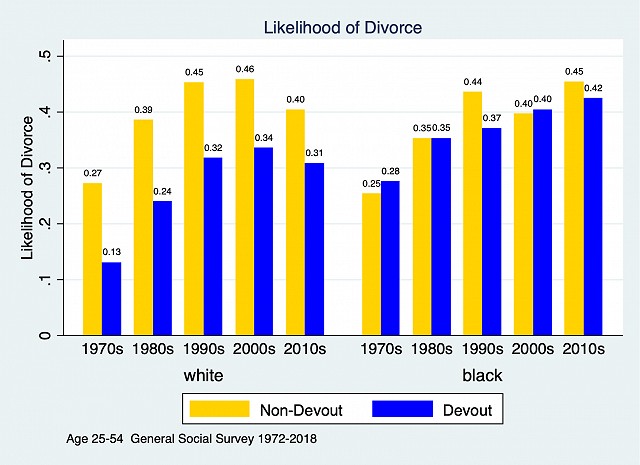
The figure above shows that divorce rates are significantly lower for white Americans who attend church regularly and this difference remains significant across all decades. The relationship between divorce and church omnipresence is harder to interpret for black Americans. Factors contributing to the much more rapid decline in spousal relationship rates for blacks may also contribute to greater instability within marriage for devout blacks, but why this would be the example is not clear.
These trends bring up an interesting question of whether married people are more than likely to frequently attend church building (pick effect) or whether frequent attenders are more probable to marry (treatment upshot)? While this is non an easy question to answer, this quick wait at GSS data shows that the merits that Christianity has no consequence on spousal relationship and divorce is grossly overstated.
Scholars who study marriage and its touch on lodge should pay greater attention to the human relationship between religion and marriage. Pastors and believers should exist encouraged that Christianity is associated with higher marriage rates and lower divorce rates for regular church attenders. Policymakers should be careful that programs to promote the welfare of families and children do non ignore the positive touch on religion may have on marriages.
There is however a lot we exercise not empathise about how faith and union influence one another. While people should probably not start going to church but on the footing of these statistics, this data should also not exist ignored past those quick to dismiss the benefits of religious conventionalities. An active organized religion appears to be connected in some way with more than stable marriages. How this connection affects health, happiness, economic outcomes, and fertility rates should all be the bailiwick of further exploration.
Contrary to what is sometimes claimed, Christians who become to church on a regular basis are more likely to ally and less probable to divorce than the general population. If existing trends continue, marriage may go on to turn down in prevalence in the United states. Only it is as well likely that faith will continue to have an insulating effect against marital decline. Commitment to one's faith appears strongly correlated with commitment to i'southward spouse, and this is a relationship that shows no indication of changing anytime shortly.
Brian J. Hollar is an Associate Professor of Economics at Marymount University in Arlington, VA. Yous tin can find him on twitter: @brianhollar.
1. Age 25-54 represent prime working and marrying years—the catamenia of life afterwards most teaching has been completed and earlier retirement.
ii. Unfortunately, when the Full general Social Survey was started in 1972, the only racial categories included were "white", "black" and "other". Since "other" represents numerous heterogeneous racial groups, this analysis focuses on "white" and "black" racial groups.
daveyfingrifuread.blogspot.com
Source: https://ifstudies.org/blog/regular-church-attenders-marry-more-and-divorce-less-than-their-less-devout-peers
0 Response to "Born Again Christians Just as Likely to Divorce as Are Non-christians"
Post a Comment