How to Read and Write the Output in File in C__
In this article, we are going to show you how to read and write to a file in the C++ programming language by using several examples. To empathise C++ file operations like read and write, we must first empathise the concept of a stream in C++.
What is a Stream?
A stream is merely a flow of data or characters. There are two types of streams: input streams and output streams. An input stream is used to read the data from an external input device such as a keyboard, while an output stream is used to write data to the external output device such as a monitor. A file can be considered as both an input and output source.
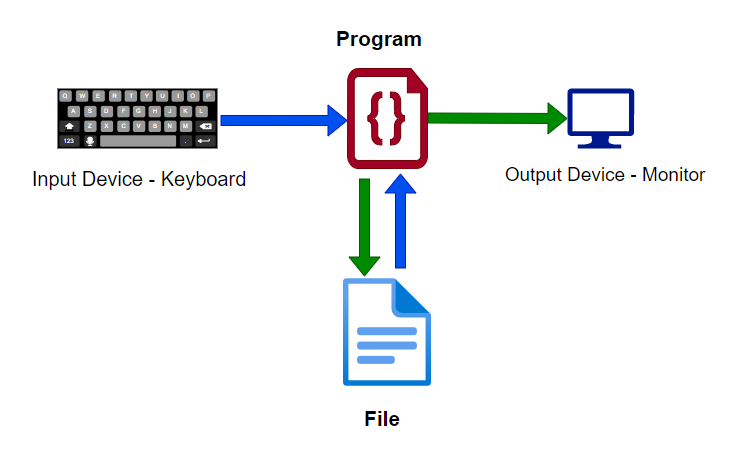
In C++, we utilise a stream to send or to receive data to or from an external source.
We can use congenital-in classes to access an input/output stream, i.due east., "ios".
Here is the stream form hierarchy of the C++ programming language:
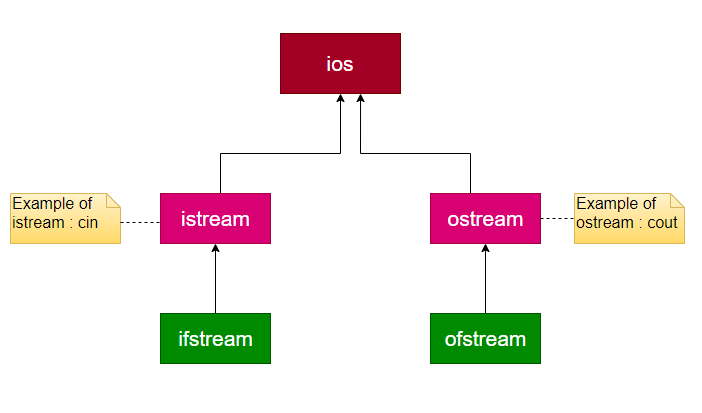
The "cin" and "cout" objects are used to read the data from the keyboard and to brandish the output on the monitor, respectively. In add-on, "ifstream," which stands for "input file stream," is used to read a stream of information from a file, and "ofstream," which stands for "output file stream," is used to write a stream of information to a file.
The "iostram.h" file contains all the required standard input/output stream classes in the C++ programming language.
Examples
Now that you lot understand the nuts of streams, we will discuss the post-obit examples to help you to meliorate understand file operations in C++:
- Example ane: Open and Close a File
- Example 2: Write to a File
- Example 3: Read from a File
- Example 4: Read and Write to a File
- Example five: Read and Write to a Binary File
Example 1: Open and Close a File
In this example program, we volition demonstrate how to open/create a file and how to close the file in C++. Every bit you can see in the below plan, we have included the library required for file operations.
To open and close a file, we need an object of ofstream. And so, to read or write to a file, we have to open up the file. We have included the fstream header file at line number-1 then that we can access ofstream course.
We have declared a myFile_Handler equally an object of ofstream inside the chief office. We can then use the open() part to create an empty file and the close() function to shut the file.
#include <fstream>
using namespace std;
int chief( )
{
ofstream myFile_Handler;
// File Open
myFile_Handler.open ( "File_1.txt" ) ;
// File Close
myFile_Handler.shut ( ) ;
return 0 ;
}
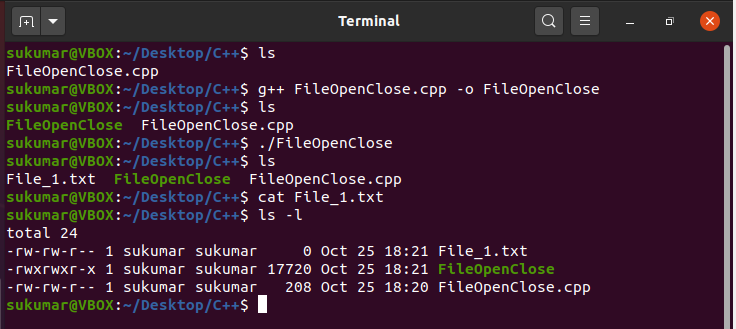
Now, nosotros will compile the plan and examine the output. As you tin see in the output window beneath, the "File_1.txt" file was created subsequently executing the program. The size of the file is zero since we have not written any content in the file.
Example 2: Write to a File
In the previous example plan, we showed y'all how to open a file and how to close the file. At present, we volition show yous how to write something in a file.
Nosotros can write to a file using the stream insertion operator, i.e., "<<". In this programme, we have used the file handler and insertion operator to write two lines in the file. The insertion operator ("<<") indicates that we are inserting the cord into the output file stream object.
#include <fstream>
using namespace std;
int main( )
{
ofstream myFile_Handler;
// File Open
myFile_Handler.open ( "File_1.txt" ) ;
// Write to the file
myFile_Handler << "This is a sample test File. " << endl;
myFile_Handler << "This is the 2d line of the file. " << endl;
// File Close
myFile_Handler.close ( ) ;
render 0 ;
}
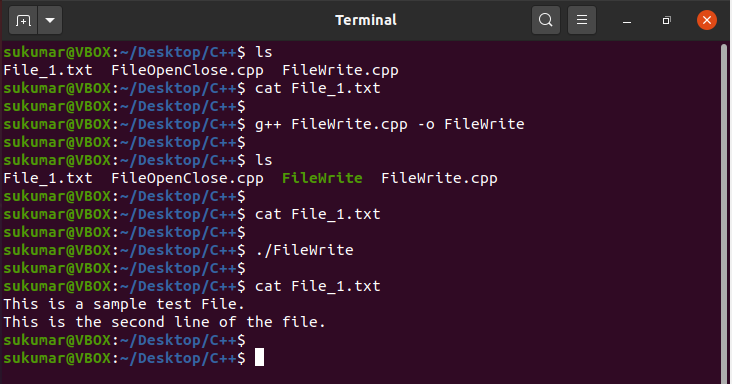
At present, we volition compile the above programme and execute it. Equally you can see below, we have successfully written to the file File_1.txt.
Example 3: Read from a File
In the previous examples, we showed you how to write content to a file. Now, let's read the content from the file that we created in Example-2 and display the content on the standard output device, i.e., the monitor.
We employ the getline() function to read the complete line from the file and and then "cout" to print the line on the monitor.
#include <iostream>
#include <fstream>
#include <string>
using namespace std;
int main( )
{
ifstream myFile_Handler;
string myLine;
// File Open in the Read Way
myFile_Handler.open ( "File_1.txt" ) ;
if (myFile_Handler.is_open ( ) )
{
// Keep reading the file
while (getline(myFile_Handler, myLine) )
{
// print the line on the standard output
cout << myLine << endl;
}
// File Close
myFile_Handler.shut ( ) ;
}
else
{
cout << "Unable to open the file!" ;
}
return 0 ;
}
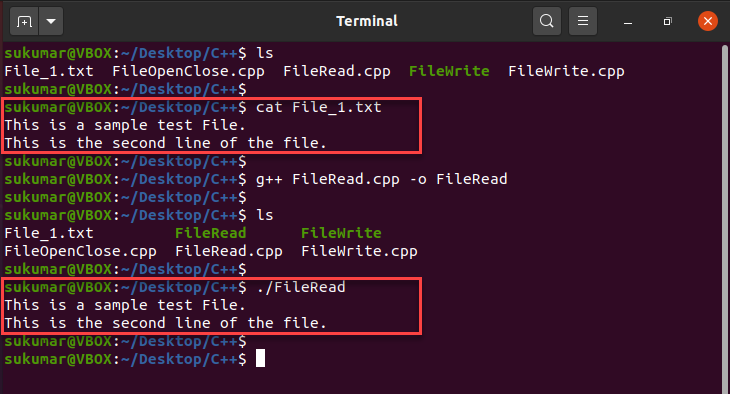
Now, we volition print the content of File_1.txt using the post-obit control: cat File_1.txt. Once we compile and execute the plan, it is clear that the output matches the content of the file. Therefore, nosotros accept successfully read the file and printed the content of the file to the monitor.
Example four: Read and Write to a File
So far, we have showed you how to open, read, write, and close a file. In C++, nosotros can as well read and write to a file at the aforementioned time. To both read and write to a file, we have to get an fstream object and open the file in "ios::in" and "ios::out" mode.
In this instance, we first write some content to the file. Then, we read the information from the file and impress it to the monitor.
#include <iostream>
#include <fstream>
#include <cord>
using namespace std;
int main( )
{
fstream myFile_Handler;
cord myLine;
// File Open
myFile_Handler.open ( "File_1.txt", ios:: in | ios:: out ) ;
// Check if the file has opened
if ( !myFile_Handler)
{
cout << "File did not open!" ;
exit ( 1 ) ;
}
// Write to the file
myFile_Handler << "i. This is another sample test File. " << endl;
myFile_Handler << "two. This is the second line of the file. " << endl;
myFile_Handler.seekg (ios:: beg ) ;
// Read the File
if (myFile_Handler.is_open ( ) )
{
// Go on reading the file
while ( getline(myFile_Handler, myLine) )
{
// impress the line on the standard output
cout << myLine << endl;
}
// File Close
myFile_Handler.shut ( ) ;
}
else
{
cout << "Unable to open the file!" ;
}
myFile_Handler.shut ( ) ;
render 0 ;
}
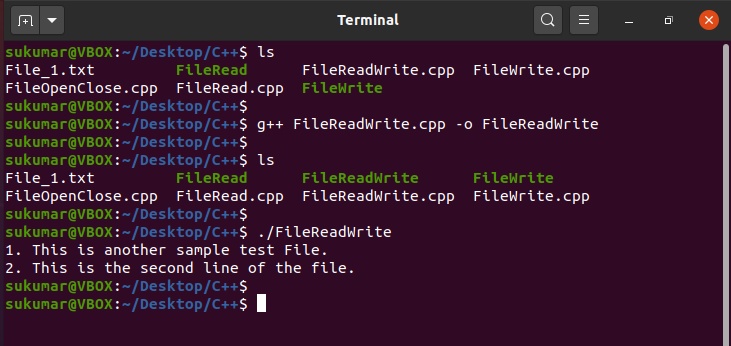
At present, nosotros will compile and execute the programme.
Example 5: Read and Write to a Binary File
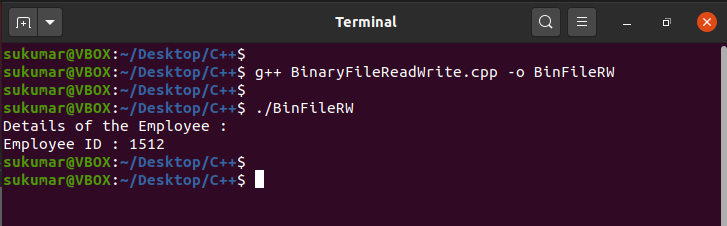
In this example, nosotros are going to declare a class so write the object to a binary file. To simplify this example, we have declared the Employee class with a public variable emp_id. And so, we volition read the binary file and print the output to the monitor.
#include <iostream>
#include <fstream>
using namespace std;
class Employee
{
public :
int emp_id;
} ;
int master( )
{
ofstream binOutFile_Handler;
ifstream binInFile_Handler;
Employee empObj_W, empObj_R;
// File Open up
binOutFile_Handler.open up ( "Employee.dat", ios:: out | ios:: binary ) ;
// Cheque if the file has opened
if ( !binOutFile_Handler)
{
cout << "File did not open!" ;
exit ( 1 ) ;
}
// Initialize empObj_W
empObj_W.emp_id = 1512 ;
// Write to the file
binOutFile_Handler.write ( ( char * ) &empObj_W, sizeof (Employee) ) ;
binOutFile_Handler.shut ( ) ;
if ( !binOutFile_Handler.good ( ) )
{
cout << "Error occured during writing the binary file!" << endl;
exit ( two ) ;
}
// Now, let'southward read the employee.dat file
binInFile_Handler.open ( "Employee.dat", ios:: in | ios:: binary ) ;
// Check if the file has opened
if ( !binInFile_Handler)
{
cout << "File did not open up!" ;
get out ( 3 ) ;
}
// Read the content of the binary file
binInFile_Handler.read ( ( char * ) &empObj_R, sizeof (Employee) ) ;
binInFile_Handler.shut ( ) ;
if ( !binInFile_Handler.good ( ) )
{
cout << "Mistake occured during reading the binary file!" << endl;
go out ( 4 ) ;
}
// Impress the output of empObj_R
cout << "Details of the Employee : " << endl;
cout << "Employee ID : " << empObj_R.emp_id << endl;
render 0 ;
}
Conclusion
Files are mainly used to store the data, and they play an important role in existent-globe programming. In this commodity, we showed you how to use various file operations with the C++ programming language by working through several examples. Furthermore, nosotros showed you how to read and write data into both text files and binary files.
About the author

I am a passionate software engineer and blogger. I accept done my Masters in Software Engineering from $.25 PILANI University, Bharat. I take very good experience in real-time software development and testing using C, C++, and Python. Follow me at thecloudstrap.com.
daveyfingrifuread.blogspot.com
Source: https://linuxhint.com/cplusplus_read_write/
0 Response to "How to Read and Write the Output in File in C__"
Post a Comment