Can a Flower Be Placed on the Gravesite Rules in Reading Massachusetts
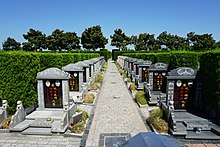
A cemetery, burial footing, gravesite or graveyard is a place where the remains of dead people are cached or otherwise interred. The discussion cemetery (from Greek κοιμητήριον , "sleeping identify")[i] [2] implies that the land is specifically designated as a burying ground and originally applied to the Roman catacombs.[3] The term graveyard is often used interchangeably with cemetery, but a graveyard primarily refers to a burial ground within a churchyard.[four] [5]
The intact or cremated remains of people may be interred in a grave, commonly referred to equally burial, or in a tomb, an "above-basis grave" (resembling a sarcophagus), a mausoleum, columbarium, niche, or other edifice. In Western cultures, funeral ceremonies are oftentimes observed in cemeteries. These ceremonies or rites of passage differ according to cultural practices and religious behavior. Modernistic cemeteries often include crematoria, and some grounds previously used for both, continue as crematoria as a principal employ long after the interment areas take been filled.
History [edit]
Palaeolithic [edit]
Taforalt cavern in Morocco is possibly the oldest known cemetery in the world. It was the resting place of at least 34 Iberomaurusian individuals, the bulk of which have been dated to 15,100 to xiv,000 years ago.
Neolithic [edit]
Neolithic cemeteries are sometimes referred to by the term "grave field". They are ane of the primary sources of information on ancient and prehistoric cultures, and numerous archaeological cultures are defined past their burial customs, such as the Urnfield civilization of the European Statuary Historic period.
Center Ages [edit]
During the Early Middle Ages, the reopening of graves and manipulation of the corpses or artifacts independent within them was a widespread miracle and a common part of the life course of early medieval cemeteries across Western and Central Europe.[6] The reopening of furnished or contempo burials occurred over the broad zone of European row-grave-style furnished inhumation burial, especially from the 5th to the 8th centuries CE, which comprised the regions of Romania, Hungary, Czechia, Slovakia, Switzerland, Austria, Germany, the Low Countries, France, and South-eastern England.[half dozen]
Early Christianity [edit]

From about the seventh century CE, in Europe a burial was nether the control of the Church and could merely have place on consecrated church basis. Practices varied, simply in continental Europe, bodies were normally cached in a mass grave until they had decomposed. The bones were and then exhumed and stored in ossuaries, either forth the arcaded bounding walls of the cemetery or within the church under floor slabs and backside walls.
In most cultures those who were vastly rich, had important professions, were part of the nobility or were of any other high social status were ordinarily cached in private crypts inside or beneath the relevant identify of worship with an indication of their name, engagement of death and other biographical data. In Europe, this was often accompanied by a depiction of their glaze of arms.
Near others were buried in graveyards over again divided by social status. Mourners who could afford the work of a stonemason had a headstone engraved with a name, dates of birth and death and sometimes other biographical information, and set up over the identify of burial. Usually, the more writing and symbols carved on the headstone, the more than expensive information technology was. As with nearly other human holding such as houses and ways of transport, richer families used to compete for the artistic value of their family headstone in comparison to others around it, sometimes adding a statue (such as a weeping affections) on the top of the grave.
Those who could not pay for a headstone at all usually had some religious symbol made from woods on the place of burial such as a Christian cross; however, this would speedily deteriorate under the rain or snow. Some families hired a blacksmith and had large crosses made from various metals put on the places of burial.
Modernity [edit]

Starting in the early on 19th century, the burial of the expressionless in graveyards began to be discontinued, due to rapid population growth in the early stages of the Industrial Revolution, continued outbreaks of infectious disease most graveyards and the increasingly limited space in graveyards for new interments. In many European states, burial in graveyards was eventually outlawed birthday through legislation.
Instead of graveyards, completely new places of burying were established away from heavily populated areas and outside of old towns and urban center centers. Many new cemeteries became municipally owned or were run by their own corporations, and thus independent from churches and their churchyards.
In some cases, skeletons were exhumed from graveyards and moved into ossuaries or catacombs. A large action of this type occurred in 18th century Paris when homo remains were transferred from graveyards all over the city to the Catacombs of Paris. The basic of an estimated vi meg people are to be found there.[7]
An early example of a landscape-style cemetery is Père Lachaise in Paris. This embodied the idea of country- rather than church-controlled burial, a concept that spread through the continent of Europe with the Napoleonic invasions. This could include the opening of cemeteries by individual or joint stock companies. The shift to municipal cemeteries or those established past private companies was usually accompanied past the establishing of landscaped burial grounds outside the city (e.g. extramural).

In Uk the movement was driven by dissenters and public health concerns. The Rosary Cemetery in Norwich was opened in 1819 as a burial ground for all religious backgrounds. Similar private non-denominational cemeteries were established near industrialising towns with growing populations, such every bit Manchester (1821) and Liverpool (1825). Each cemetery required a separate Act of Parliament for authorisation, although the capital was raised through the formation of articulation-stock companies.
In the first 50 years of the 19th century the population of London more than doubled from ane million to two.three meg. The pocket-size parish churchyards were chop-chop becoming dangerously overcrowded, and decaying matter infiltrating the water supply was causing epidemics. The issue became particularly astute after the cholera epidemic of 1831, which killed 52,000 people in Britain alone, putting unprecedented pressure on the land's burying capacity. Concerns were also raised virtually the potential public wellness hazard arising from the inhalation of gases generated from man putrefaction under the and then prevailing miasma theory of illness.
Legislative action was dull in coming, but in 1832 Parliament finally acknowledged the need for the establishment of large municipal cemeteries and encouraged their construction outside London. The same beak also closed all inner London churchyards to new deposits. The Magnificent 7, seven large cemeteries around London, were established in the following decade, starting with Kensal Green in 1832.[8]
Urban planner and author John Claudius Loudon was one of the start professional cemetery designers, and his book On the Laying Out, Planting and Managing of Cemeteries (1843) was very influential on designers and architects of the period. Loudon himself designed three cemeteries – Bath Abbey Cemetery, Histon Road Cemetery, Cambridge, and Southampton Former Cemetery.[9]
The Metropolitan Burying Human action of 1852 legislated for the establishment of the starting time national system of government-funded municipal cemeteries across the land, opening the way for a massive expansion of burial facilities throughout the late 19th century.[10]
In the The states, rural cemeteries became recreational areas in a time before public parks, hosting events from coincidental picnics to hunts and carriage races.[11] [12]
Types [edit]


The Laird'due south traditional Scottish graveyard at Kindrogan House, Strathardle.


The 1,400 square feet (130 mii) plot pictured hither has the graves of 19 members of the Hillendahl family, including 1 who was interred in 1854, in the Spring Co-operative area of Houston, Texas, United states. A descendant of the family unit sold all of the land around the grave site, but refused to movement the actual graves.[xiii]
In that location are a number of different styles of cemetery in use. Many cemeteries have areas based on unlike styles, reflecting the variety of cultural practices effectually expiry and how information technology changes over fourth dimension.
Urban [edit]
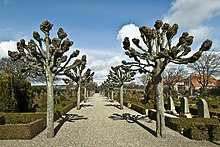

The urban cemetery is a burial ground located in the interior of a village, boondocks, or city. Early urban cemeteries were churchyards, which filled quickly and exhibited a haphazard placement of burial markers as sextons tried to squeeze new burials into the remaining space. Equally new burying grounds were established in urban areas to compensate, burial plots were often laid out in a grid to replace the cluttered appearance of the churchyard.[14] Urban cemeteries developed over fourth dimension into a more landscaped form as part of borough development of beliefs and institutions that sought to portray the city as civilized and harmonious.[xv]
Urban cemeteries were more sanitary (a place to safely dispose of decomposing corpses) than they were aesthetically pleasing. Corpses were normally buried wrapped in cloth, since coffins, burial vaults, and in a higher place-ground crypts inhibited the process of decomposition.[sixteen] Nonetheless, urban cemeteries which were heavily used were often very unhealthy. Receiving vaults and crypts often needed to be aired before inbound, every bit decomposing corpses used upward then much oxygen that even candles could not remain lit.[17] The sheer stench from decomposing corpses, even when buried deeply, was overpowering in areas next to the urban cemetery.[18] [19] Decomposition of the man body releases significant pathogenic bacteria, fungi, protozoa, and viruses which can cause disease and illness, and many urban cemeteries were located without consideration for local groundwater. Modern burials in urban cemeteries as well release toxic chemicals associated with embalming, such as arsenic, formaldehyde, and mercury. Coffins and burying equipment tin as well release pregnant amounts of toxic chemicals such as arsenic (used to preserve coffin wood) and formaldehyde (used in varnishes and as a sealant) and toxic metals such as copper, lead, and zinc (from coffin handles and flanges).[20]
Urban cemeteries relied heavily on the fact that the soft parts of the body would decompose in about 25 years (although, in moist soil, decomposition can take up to 70 years).[21] If room for new burials was needed, older bones could exist dug up and interred elsewhere (such as in an ossuary) to make infinite for new interments.[16] Information technology was not uncommon in some places, such equally England, for fresher corpses to be chopped up to aid decomposition, and for bones to be burned to create fertilizer.[22] The re-utilise of graves allowed for a steady stream of income, which enabled the cemetery to remain well-maintained and in proficient repair.[23] Not all urban cemeteries engaged in re-employ of graves, and cultural taboos often prevented it. Many urban cemeteries accept fallen into busted and become overgrown, as they lacked endowments to fund perpetual care. Many urban cemeteries today are thus home to wildlife, birds, and plants which cannot be found anywhere else in the urban area, and many urban cemeteries in the tardily 20th century touted their role as an environmental refuge.[24] [25]
Many urban cemeteries are characterized past multiple burials in the same grave. Multiple burials is a event of the express size of the urban cemetery, which cannot easily expand due to adjacent edifice development. It was not uncommon for an urban cemetery to begin adding soil to the height of the cemetery to create new burial infinite.
Monumental [edit]
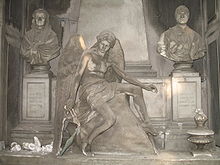
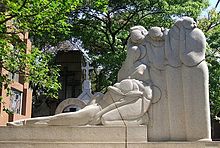
A monumental cemetery is the traditional fashion of cemetery where headstones or other monuments made of marble, granite or similar materials ascension vertically to a higher place the ground (typically around 50 cm but some can be over 2 metres loftier). Oftentimes the unabridged grave is covered by a slab, commonly concrete, but it can be more expensive materials such as marble or granite, and/or has its boundaries delimited by a fence which may exist made of concrete, cast iron or timber. Where a number of family members are buried together (either vertically or horizontally), the slab or boundaries may encompass a number of graves.
Awe-inspiring cemeteries are often regarded equally cruddy due to the random drove of monuments and headstones they contain. Also, every bit maintenance of the headstones is the responsibleness of family members (in the absence of a proscribed Perpetual Intendance and Maintenance Fund), over time many headstones are forgotten well-nigh and decay and become damaged. For cemetery regime, monumental cemeteries are difficult to maintain. While cemeteries oft have grassed areas between graves, the layout of graves makes information technology difficult to use modern equipment such as ride-on lawn mowers in the cemetery. Often the maintenance of grass must exist washed by more labour-intensive (and therefore expensive) methods. In order to reduce the labour price, devices such as string trimmers are increasingly used in cemetery maintenance,[ citation needed ] but such devices can damage the monuments and headstones. Cemetery authorities dislike the criticism they receive for the deteriorating condition of the headstones, arguing that they have no responsibility for the upkeep of headstones, and typically disregard their own maintenance practices as being one of the causes of that deterioration.[ citation needed ]
Rural or garden [edit]



Old graveyard in Elazig, Turkey

A Muslim cemetery at sunset in Marrakech, Morocco
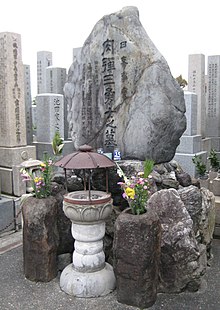
A cemetery in Kyoto, Japan


The rural cemetery or garden cemetery[26] is a style of burying ground that uses landscaping in a park-like setting. It was conceived in 1711 past the British architect Sir Christopher Wren, who advocated the creation of landscaped burial grounds which featured well-planned walkways which gave extensive access to graves and planned plantings of trees, bushes, and flowers.[27] Wren's idea was not immediately accustomed. But by the early on 1800s, existing churchyards were growing overcrowded and unhealthy, with graves stacked upon each other or emptied and reused for new burials.[28] Equally a reaction to this, the beginning "garden" cemetery – Père Lachaise Cemetery in Paris – opened in 1804.[29] Because these cemeteries were unremarkably on the outskirts of town (where land was plentiful and cheap), they were called "rural cemeteries", a term nevertheless used to depict them today.[28] The concept quickly spread across Europe.[30]
Garden/rural cemeteries were non necessarily outside city limits. When land within a city could exist plant, the cemetery was enclosed with a wall to requite it a garden-like quality. These cemeteries were often not sectarian, nor co-located with a house of worship. Inspired by the English landscape garden movement,[31] they frequently looked like attractive parks. The first garden/rural cemetery in the United States was Mount Auburn Cemetery near Boston, Massachusetts, founded by the Massachusetts Horticultural Society in 1831.[32] Following the establishment of Mount Auburn, dozens of other "rural" cemeteries were established in the Usa – mayhap in office because of Supreme Court Justice Joseph Story's dedication address – and there were dozens of dedication addresses,[33] including the famous Gettysburg Address of President Abraham Lincoln.
The toll of building a garden/rural cemetery frequently meant that just the wealthy could beget burial in that location.[34] Subsequently, garden/rural cemeteries often characteristic above-ground monuments and memorials, mausoleums, and columbaria. The excessive filling of rural/garden cemeteries with elaborate above-basis memorials, many of dubious creative quality or gustation, created a backfire which led to the development of the lawn cemetery.[35]
Lawn cemetery [edit]
In a review of British burial and decease practises, Julie Rugg wrote that at that place were "four closely interlinked factors that explain the 'invention' and widespread adoption of the lawn cemetery: the deterioration of the Victorian cemetery; a self-conscious rejection of Victorian aesthetics in favour of mod alternatives; resources difficulties that, particularly after World State of war Ii, increasingly constrained what might be accomplished in terms of cemetery maintenance; and growing professionalism in the field of cemetery management."[36]

Typically, lawn cemeteries comprise a number of graves in a backyard setting with trees and gardens on the perimeter. Adolph Strauch introduced this mode in 1855 in Cincinnati.[37] While aesthetic appeal to family members has been the primary driver for the development of lawn cemeteries, cemetery regime initially welcomed this new mode of cemetery enthusiastically, expecting easier maintenance. Selecting (or grading) the country intended for a backyard cemetery so that it is completely apartment allows the use of big efficient mowers (such every bit ride-on mowers or lawn tractors) - the plaques (being horizontally set up in the ground) lie below the level of the blades and are not damaged by the blades. Unfortunately, in practice, while families are often initially attracted to the uncluttered appearance of a lawn cemetery, the mutual exercise of placing flowers (sometimes in vases) and increasingly other items (e.g. small-scale toys on children's graves) re-introduces some ataxia to the cemetery and makes it hard to use the larger mowers. While cemetery government increasingly impose restrictions on the nature and type of objects that can be placed on lawn graves and actively remove prohibited items, grieving families are often unwilling to comply with these restrictions and go very upset if the items are removed. Another trouble with lawn cemeteries involves grass over-growth over time: the grass can abound over and comprehend the plaque, to the distress of families who can no longer easily locate the grave. Grasses that propagate by an higher up-ground stolon (runner) can encompass a plaque very quickly. Grasses that propagate by a below-basis rhizome tend not to cover the plaque as easily.


Lawn axle [edit]
The lawn axle cemetery, a recent development, seeks to solve the problems of the backyard cemetery while retaining many of its benefits. Low (10–15 cm) raised physical slabs (beams) are placed across the cemetery. Commemorative plaques (usually standardised in terms of size and materials similar to lawn cemeteries) stand on these beams next to each grave. As in a lawn cemetery, grass grows over the graves themselves. The areas between the beams are wide enough to permit easy mowing with a larger mower. As the mower blades are fix lower than the top of the axle and the mowers do not go over the beam, the blades cannot damage the plaques. Upwardly on the beam, the plaques cannot be easily overgrown past grass, and spaces between the plaques permit families to identify flowers and other objects out of reach of the mowing.
Natural [edit]
A natural cemetery, eco-cemetery, dark-green cemetery or conservation cemetery, is a new style of cemetery as an area set aside for natural burials (with or without coffins). Natural burials are motivated by a want to be environmentally witting with the trunk quickly decomposing and becoming part of the natural surround without incurring the ecology cost of traditional burials. Certifications may be granted for various levels of light-green burying. Light-green burying certifications are issued in a tiered system reflecting level of natural burying exercise. Green burial certification standards designate a cemetery as Hybrid, Natural, or Conservation Burial Grounds.
Many scientists have argued that natural burials would be a highly efficient use of land if designed specifically to save endangered habitats, ecosystems and species.[38]
The opposite has as well been proposed. Instead of letting natural burials permanently protect wild landscapes, others have argued that the rapid decomposition of a natural burying, in principle, allows for the quick re-utilise of grave sites in comparison with conventional burials. However, it is unclear if reusing cemetery land volition be culturally adequate to near people.
In keeping with the intention of "returning to nature" and the early re-use potential, natural cemeteries do not normally take conventional grave markings such as headstones. Instead, verbal GPS recordings and or the placing of a tree, bush-league or rock frequently marks the location of the dead, and then grieving family and friends tin visit the precise location of a grave.
Columbarium wall [edit]

Columbarium walls are a common feature of many cemeteries, reflecting the increasing employ of cremation rather than burial. While cremated remains can be kept at habitation past families in urns or scattered in some pregnant or attractive identify, neither of these approaches allows for a long-lasting commemorative plaque to honour the expressionless nor provide a place for the wider circle of friends and family to come to mourn or visit. Therefore, many cemeteries at present provide walls (typically of brick or rendered brick construction) with a rectangular array of niches, with each niche being big enough to suit a person'due south cremated remains. Columbarium walls are a very infinite-efficient apply of land in a cemetery compared with burials and a niche in a columbarium wall is a much cheaper alternative to a burial plot. A small plaque (nigh 15 cm ten 10 cm) can be affixed beyond the front of each niche and is by and large included as part of the cost of a niche. As the writing on the plaques has to be adequately modest to fit on the small size of the plaque, the design of columbarium walls is constrained by the ability of visitors to read the plaques. Thus, the niches are typically placed between ane metre to 2 metres above the ground so the plaques can be easily read by an adult. Some columbarium walls accept niches going close to ground level, only these niches are usually unpopular with families as it is difficult to read the plaque without angle downwardly very low (something older people in particular find hard or uncomfortable to do).
As with graves, the niches may be assigned by the cemetery authorities or families may choose from the unoccupied niches available. Information technology is usually possible to purchase (or pay a deposit) to reserve the utilise of adjacent niches for other family members. The use of adjacent niches (vertically or horizontally) usually permits a larger plaque spanning all the niches involved, which provides more space for the writing. Every bit with graves, in that location may be separate columbarium walls for dissimilar religions or for war veterans. As with lawn cemeteries, the original expectation was that people would prefer the uncluttered simplicity of a wall of plaques, just the do of leaving flowers is very entrenched. Mourners leave flowers (and other objects) on tiptop of columbarium walls or at the base, equally close as they can to the plaque of their family member. In some cases, information technology is possible to clasp a slice of wire or string nether the plaque allowing a flower or small posy to be placed on the plaque itself or clips are glued onto the plaque for that purpose. Newer designs of columbarium walls take this desire to leave flowers into account by incorporating a metal clip or loop beside each plaque, typically designed to hold a single flower stem or a minor posy. Every bit the flowers decay, they only fall to the ground and exercise not create a significant maintenance problem.
Family [edit]

Holland Cemetery: A rural cemetery in northeast Oklahoma

Family cemeteries in Bharat

While uncommon today, family (or private) cemeteries were a matter of practicality during the settlement of America. If a municipal or religious cemetery had not been established, settlers would seek out a pocket-size plot of land, oftentimes in wooded areas bordering their fields, to begin a family unit plot. Sometimes, several families would accommodate to bury their expressionless together. While some of these sites afterwards grew into true cemeteries, many were forgotten after a family moved away or died out.
Today, it is not unheard of to observe groupings of tombstones, ranging from a few to a dozen or more, on undeveloped state. Every bit late 20th-century suburban sprawl pressured the step of evolution in formerly rural areas, it became increasingly common for larger exurban properties to be burdened by "religious easements", which are legal requirements for the belongings possessor to allow periodic maintenance of small burial plots located on the property but technically not owned with it. Often, cemeteries are relocated to accommodate edifice. However, if the cemetery is non relocated, descendants of people buried there may visit the cemetery.[39]
There is also the do of families with large estates choosing to create private cemeteries in the class of burial sites, monuments, crypts, or mausoleums on their property; the mausoleum at Fallingwater is an case of this practice. Burial of a torso at a site may protect the location from redevelopment, with such estates oftentimes existence placed in the care of a trust or foundation. In the U.s., state regulations have made it increasingly difficult, if non impossible, to first private cemeteries; many require a plan to intendance for the site in perpetuity. Private cemeteries are nearly always forbidden on incorporated residential zones. Many people will coffin a honey pet on the family property.
Arabian tribal [edit]
All of the Saudis in Al Baha are Muslims, and this is reflected in their cemetery and funeral customs. "The southern tribal hinterland of Baha – home to peculiarly the Al-Ghamdi and Al-Zahrani tribes – has been renowned for centuries for their tribal cemeteries that are now slowly vanishing", according to the Asharq Al-Awsat newspaper: "I old villager explained how tribal cemeteries came about. 'People used to die in large numbers and very chop-chop one later on the other because of diseases. So the villagers would dig graves close past burying members of the aforementioned family in i area. That was how the family and tribal burial grounds came virtually... If the family ran out of space, they would open up onetime graves where family unit members had been buried before and add more people to them.
This procedure is known as khashf. During famines and outbreaks of epidemics huge numbers of people would die and many tribes faced difficulties in earthworks new graves because of the hard weather condition. In the past, some Arab winters lasted for more than than six months and would be accompanied with much rain and fog, impeding movement. Just due to tribal rivalries many families would guard their cemeteries and put restrictions on who was cached in them. Across Baha, burial grounds take been constructed in dissimilar ways. Some cemeteries consist of underground vaults or concrete burial chambers with the chapters of holding many bodies simultaneously. Such vaults include windows for people to peer through and are usually decorated ornately with text, drawings, and patterns. At least i resident believes that the graves unique in the region because many are not oriented toward Mecca, and therefore must pre-date Islam.[40]
Terraced [edit]
Graves are terraced in Yagoto Cemetery, which is an urban cemetery situated in a hilly expanse in Nagoya, Nihon, effectively creating stone walls blanketing hillsides.[41]
Miscellaneous [edit]
The Cross Bones is a burial ground for prostitutes in London. The Neptune Memorial Reef is an underwater columbarium almost Cardinal Biscayne.[42]
Online memorials [edit]
In the 2000s and 2010s, information technology has become increasingly common for cemeteries and funeral homes to offer online services. There are also stand up-alone online "cemeteries" such as Observe a Grave, Canadian Headstones, Interment.internet, and the World Wide Cemetery.[43] [44]
Customs and practices [edit]
Flowers [edit]

In Western countries, and many others,[ quantify ] visitors to graves unremarkably go out cutting flowers, specially during major holidays and on birthdays or relevant anniversaries. Cemeteries usually dispose of these flowers after a few weeks in gild to proceed the space maintained. Some companies offering perpetual blossom services, to ensure a grave is e'er busy with fresh flowers.[45] Flowers may often be planted on the grave besides, commonly immediately in front of the gravestone. For this purpose roses are highly mutual.
In some regions flowers are put out at specific times called Decoration Days.
Stones [edit]

Small stones on a gravestone in a Jewish cemetery in Germany
Visitors to loved ones interred in Jewish cemeteries oft leave a small rock on the top of the headstone. There are prayers said at the gravesite, and the stone is left on the visitor's deviation. It is done as a evidence of respect; equally a full general dominion, flowers are not placed at Jewish graves. Flowers are fleeting; the symbology inherent in the use of a stone is to show that the beloved, honor, memories, and soul of the loved one are eternal. This practice is seen in the closing scene of the moving-picture show Schindler's Listing, although in that case it is not on a Jewish grave.
Crosses [edit]

Wooden crosses with remembrance poppies on them
War graves volition usually have minor timber remembrance crosses left with a cherry-red poppy attached to its centre. These volition often have letters written on the cantankerous. More formal visits will oftentimes leave a poppy wreath. Jewish war graves are sometimes marked by a timber Star of David.
Candles [edit]

Placing burning grave candles on the cemetery to commemorate the dead is a very common tradition in Catholic nations, for case, Poland. It is mostly practised on All Souls' Mean solar day. The traditional grave candles are called znicz in Smooth.[46] A similar practise of grave candles is also used in Eastern Orthodox Christian nations, besides as the Lutheran Christian Nordic countries.
Toys [edit]
In the American S, graves of children are frequently decorated with emblems of childhood. These include favorite toys, balloons, seasonal decorations, religious figurines, and more than.[47]
Gimmicky management [edit]
Traditionally cemetery management only involves the allocation of land for burying, the digging and filling of graves, and the maintenance of the grounds and landscaping. The construction and maintenance of headstones and other grave monuments are ordinarily the responsibilities of surviving families and friends. Notwithstanding, increasingly, many people regard the resultant collection of individual headstones, concrete slabs and fences (some of which may be decayed or damaged) to be aesthetically unappealing, leading to new cemetery developments either standardising the shape or pattern of headstones or plaques, sometimes by providing a standard shaped mark every bit role of the service provided by the cemetery.
Grave earthworks [edit]
Cemetery authorities normally employ a full-time staff of caretakers to dig graves. The term "gravedigger" is all the same used in casual spoken language, though many cemeteries accept adopted the term "caretaker", since their duties often involve maintenance of the cemetery grounds and facilities. The employment of skilled personnel for the preparation of graves is washed non only to ensure the grave is dug in the correct location and at the correct depth, but also to relieve families from having to dig the grave for a recently dead relative, and as a matter of public safety, in order to forestall inexperienced visitors from injuring themselves, to ensure unused graves are properly covered, and to avoid legal liability that would result from an injury related to an improperly dug or uncovered grave. Grooming of the grave is usually done earlier the mourners go far for the burial. The cemetery caretakers fill the grave later on the burying, generally subsequently the mourners have departed. Mechanical equipment, such as backhoes, are used to reduce labour cost of excavation and filling, only some mitt shovelling may nevertheless be required.
In the United Kingdom the minimum depth from the surface to the highest lid is 36 inches (91.4 cm). There must be 6 inches (15.ii cm) between each bury, which on average is fifteen inches (38.ane cm) loftier. If the soil is free-draining and porous, but 24 inches (61 cm) of soil on top is required. Coffins may be interred at lesser depths or fifty-fifty to a higher place ground every bit long as they are encased in a concrete chamber.[48] Before 1977, double graves were dug to viii anxiety (243.8 cm) and singles to 6 feet (182.9 cm). As a single grave is at present dug to 54 inches (137.2 cm), old cemeteries contain many areas where new unmarried graves can be dug on "sometime footing". This is considered a valid method of resource management and provides income to keep older cemeteries viable, thus forestalling the need for permanent closure, which would consequence in a reduction of their piece of work force.
Cemetery key [edit]

Cemetery key of a pastor with a hand-in-paw era around 1935
The primal is a zental element of Christianity.[49] Keys of death and hell equally a metaphor and synonym for these often stands the cemetery key. - "Christ says: I was dead, and behold, I am live from eternity to eternity, and have the keys of decease and hell." (Revelation ane:18). Peter is given privilege to permit different groups to enter the Kingdom of Heaven. He gets three keys that he uses. (Acts 2:37, 38; viii:xiv-17; 10:44-48) Today information technology is also integrated in many games equally the "graveyard primal holder".[l]
Burying registers [edit]
Usually there is a legal requirement to maintain records regarding the burials (or interment of ashes) within a cemetery. These burying registers usually incorporate (at a minimum) the name of the person buried, the date of burial and the location of the burial plots within the cemetery, although some comprise far more detail. The Arlington National Cemetery, one of the Usa' largest military cemeteries, has a registry, The ANC Explorer, which contains details such equally photographs of the forepart and dorsum of the tombstones.[51] Burial registers are an of import resource for genealogy.
Land use [edit]
In social club to physically manage the space within the cemetery (to avoid burials in existing graves) and to record locations in the burying register, near cemeteries take some systematic layout of graves in rows, generally grouped into larger sections equally required. Ofttimes the cemetery displays this information in the form of a map, which is used both by the cemetery assistants in managing their country use and also by friends and family members seeking to locate a particular grave within the cemetery.
Pressures [edit]
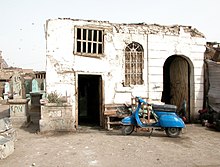
A tomb retrofitted equally a residence in the City of the Expressionless. Cairo'southward City of the Dead is a centuries-old cemetery that has become home to equally many every bit 1 1000000 Egyptians during the last decades.[52]
Cemetery authorities face a number of tensions in regard to the direction of cemeteries.
One issue relates to cost. Traditionally a single payment is made at the time of burial, simply the cemetery say-so incurs expenses in cemetery maintenance over many decades. Many cemetery authorities detect that their accumulated funds are not sufficient for the costs of long-term maintenance. This shortfall in funds for maintenance results in three main options: charge much higher prices for new burials, obtain some other kind of public subsidy, or fail maintenance. For cemeteries without space for new burials, the options are even more than limited. Public attitudes towards subsidies are highly variable. People with family cached in local cemeteries are usually quite concerned about fail of cemetery maintenance and volition normally fence in favour of public subsidy of local cemetery maintenance, whereas other people without personal connectedness to the cemetery often debate that public subsidies of individual cemeteries is an inappropriate use of their taxes. Some jurisdictions crave a sure amount of money be set bated in perpetuity and invested and so that the interest earned can be used for maintenance.[53]
Another issue relates to limited corporeality of country. In many larger towns and cities, the older cemeteries which were initially considered to be large frequently run out of space for new burials and at that place is no vacant next state available to extend the cemetery or fifty-fifty state in the same full general area to create new cemeteries. New cemeteries are generally established on the periphery of towns and cities, where large tracts of state are still available. However, people often wish to exist buried in the same cemetery as other relatives, and are non interested in being buried in new cemeteries with which there is no sense of connectedness to their family unit, creating force per unit area to find more infinite in existing cemeteries.
A tertiary effect is the maintenance of monuments and headstones, which are mostly the responsibility of families, but often become neglected over time. Decay and damage through vandalism or cemetery maintenance practices can render monuments and headstones either unsafe or at to the lowest degree cruddy. On the other hand, some families do not forget the grave merely constantly visit, leaving behind flowers, plants, and other decorative items that create their own maintenance problem.
Re-utilize of graves [edit]

Prague's Old Jewish Cemetery is the last resting place for more than than 100,000 people who had been cached here since the 15th century.

All of these issues tend to put force per unit area on the re-use of grave sites within cemeteries. The re-employ of graves already used for burial can cause considerable upset to family members. Although the authorities might declare that the grave is sufficiently old that there will be no human remains still present, nonetheless many people regard the re-use of graves (particularly their family's graves) as a desecration. Also re-use of a used grave involves the removal of any monuments and headstones, which may crusade further distress to families (although families will typically be immune to take away the monuments and headstones if they wish).
On the other hand, cemetery authorities are well aware that many old graves are forgotten and not visited and that their re-utilise will not crusade distress to anyone. Even so, in that location may be some older graves in a cemetery for whom there are local and vocal descendants who will mount a public campaign against re-use. Ane pragmatic strategy is to publicly announce plans to re-apply older graves and invite families to respond if they are willing or not. Re-use then only occurs where in that location are no objections allowing the "forgotten" graves to exist re-used. Sometimes the cemetery authorities request a further payment to avert re-utilize of a grave, but often this backfires politically.
A practical problem with regard to contacting families is that the person who initially purchased the burial plot(s) may have after died and locating living family members, if whatever, many decades later is virtually incommunicable (or at least prohibitively expensive). Public discover well-nigh the proposed re-employ of graves may or may non reach family members living further afield who may object to such practices. Therefore, it is possible that re-use could occur without family unit awareness.
Some cemeteries did foresee the need for re-use and included in their original terms and conditions a limited tenure on a grave site and most new cemeteries follow this practice, having seen the bug faced by older cemeteries. Common practice in Europe is to place bones in an ossuary after the proscribed burying period is over.[53]
Nevertheless, fifty-fifty when the cemetery has the legal right to re-use a grave, stiff public stance often forces the authorities to back down on that re-use. Also, even when cemeteries have a limited tenure provision in place, funding shortages tin force them to contemplate re-utilize earlier than the original arrangements provided for.
Another blazon of grave site considered for re-use are empty plots purchased years ago just never used. In principle it would seem easier to "re-employ" such grave sites as at that place can be no claims of desecration, but often this is made complicated by the legal rights to be buried obtained by the pre-buy, as any limited tenure clause only takes effect later there has been a burial. Over again, cemetery authorities suspect that in many cases the holders of these burial rights are probably dead and that nobody will practise that burial right, merely again some families are aware of the burial rights they possess and do intend to exercise them as and when family members die. Again the difficulty of being unable to locate the holders of these burial rights complicates the re-employ of those graves.
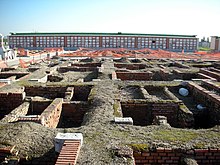
Cemetery excavations, like this i in Madrid, can convalesce overcrowding.
As historic cemeteries begin to attain their chapters for total burials, alternative memorialization, such as commonage memorials for cremated individuals, is becoming more than common. Different cultures have different attitudes to destruction of cemeteries and apply of the state for structure. In some countries information technology is considered normal to destroy the graves, while in others the graves are traditionally respected for a century or more than. In many cases, later on a suitable flow of time has elapsed, the headstones are removed and the now sometime cemetery is converted to a recreational park or structure site. A more contempo trend, particularly in South American cities, involves constructing loftier-rise buildings to firm graves.[54]
Cemeteries in the United states of america may be relocated if the state is required for other reasons. For instance, many cemeteries in the southeastern U.s. were relocated by the Tennessee Valley Authority from areas nearly to be flooded by dam construction.[55] Cemeteries may also be moved then that the land can exist reused for transportation structures,[56] [57] public buildings,[58] or even private development.[59] Cemetery relocation is not necessarily possible in other parts of the world; in Alberta, Canada, for instance, the Cemetery Act expressly forbids the relocation of cemeteries or the mass exhumation of marked graves for whatsoever reason whatsoever.[lx] This has caused meaning issues in the provision of transportation services to the southern one-half of the Metropolis of Calgary, as the main southbound road connecting the south terminate of the city with downtown threads through a series of cemeteries founded in the 1930s. The calorie-free rail transit line running to the south end eventually had to be built directly under the road.

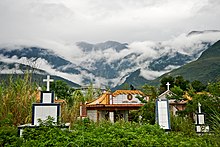
A belltower at Wood Abode Cemetery, in Fifield, Wisconsin. Tolling bells during funerals has been customary in some places effectually the earth.
Superstitions [edit]

In many countries, cemeteries are places believed to hold both superstition and legend characteristics, being used, commonly at night times, as an altar in supposed black magic ceremonies or similarly surreptitious happenings, such as devil worshipping, grave-robbing (aureate teeth and jewelry are preferred), thrilling sexual activity encounters, or drug and alcohol abuse not related to the cemetery aura.
The fable of zombies, as romanticized past Wade Davis in The Serpent and the Rainbow, is not infrequent among cemetery myths, as cemeteries are believed to be places where witches and sorcerers get skulls and basic needed for their sinister rituals.
In the Afro-Brazilian urban mythos (such equally Umbanda), at that place is a character loosely related to cemeteries and its aura: the Zé Pilintra (in fact, Zé Pilintra is more related to bohemianism and dark life than with cemeteries, where the reigning entity is Exu Caveira or Exu Cemitério, similar to Voodoo Baron Samedi).
Run into also [edit]
- Corpse road
- Pet cemetery
- Prison cemetery
- Lists of cemeteries past country
- Catacomb
- Churchyard
- Coemeterium
- Columbarium
- Catacomb
- Grave field
- Mass grave
- Necropolis
- Ossuary
- Tomb
- Tumulus
- Unmarked grave
- State of war grave
References [edit]
- ^ κοιμητήριον . Liddell, Henry George; Scott, Robert; A Greek–English Lexicon at the Perseus Project
- ^ Harper, Douglas. "cemetery". Online Etymology Dictionary.
- ^ "cemetery". Oxford English Dictionary (Online ed.). Oxford University Press. (Subscription or participating institution membership required.)
- ^ Upendran, Due south. (October 25, 2011). "Know Your English: Difference between 'graveyard' and 'cemetery'". The Hindu.
- ^ "What's the Deviation Betwixt a Graveyard and a Cemetery". January 19, 2013.
- ^ a b Klevnäs, Alison; Aspöck, Edeltraud; Noterman, Astrid A.; van Haperen, Martine C.; Zintl, Stephanie (August 2021). "Reopening graves in the early Middle Ages: from local practice to European phenomenon". Antiquity: A Review of World Archeology. Cambridge: Cambridge University Press. 95 (382): 1005–1026. doi:10.15184/aqy.2020.217. eISSN 1745-1744. ISSN 0003-598X.
- ^ "Paris' Undercover Underworld". CBS News. September 27, 2004
- ^ Meller, Hugh (1981). London Cemeteries: An Illustrated Guide and Gazetteer. Amersham: Avebury. ISBN978-0861270033.
- ^ Melanie Louise Simo (1988) Loudon and the Landscape, p. 283.
- ^ "Friends of Beckett Street Cemetery". beckettstreetcemetery.org.uk.
- ^ Rebecca Greenfield (March xvi, 2011). "Our First Public Parks: The Forgotten History of Cemeteries". The Atlantic.
- ^ Blanche Linden-Ward (1989). "12 Foreign but Genteel Pleasance Grounds: Tourist and Leisure Uses of Nineteenth-Century Rural Cemeteries". Cemeteries & Gravemarkers. Academy Press of Colorado, Utah Land University Printing. pp. 293–328. doi:ten.2307/j.ctt46nqxw.xix. ISBN9780874211603. JSTOR j.ctt46nqxw.19.
- ^ Lomax, John Nova. "The Seoul of Houston: The Atmospheric condition Was Not the Strong Point on Long Point Archived 2008-08-29 at the Wayback Machine." Houston Press. January 30, 2008.
- ^ Mytum 2004, p. 50.
- ^ Worpole 2003, pp. xi–12.
- ^ a b Nonini 2014, p. 390.
- ^ Flanders 2014, p. 220.
- ^ Carroll 2013, p. 362.
- ^ Upton 1997, p. 131–132.
- ^ Taylor & Allen 2006, pp. 342–342.
- ^ Meuser 2010, p. 137.
- ^ Flanders 2014, pp. 219–221.
- ^ Worpole 2003, p. viii.
- ^ Worpole 2003, p. 173.
- ^ Forman 2014, pp. 357–358.
- ^ Keels 2003, p. 21.
- ^ van Rensslaer, Grand. G. (June 3, 1891). "Garden and Forest". Sir Christopher Wren as Gardener: 254–255.
- ^ a b LeeDecker 2009, pp. 145, 148.
- ^ Thomas 2003, p. 32.
- ^ Mickey 2013, p. 17.
- ^ Vercelloni & Vercelloni 2010, p. 198.
- ^ Hodgson 2001, p. thirty.
- ^ Brophy, Alfred (2016). "The Route to the Gettysburg Accost" (PDF). Florida State University Law Review. 43: 831–905.
- ^ Harney 2014, p. 102.
- ^ Mytum 2004, p. 51.
- ^ Rugg, Julie (2006). "Lawn cemeteries: the emergence of a new mural of decease". Urban History. 33 (2): 213–233. doi:10.1017/S0963926806003786. ISSN 0963-9268. S2CID 145306627.
- ^ Sears, John F. (1989). Sacred Places: American Tourist Attractions in the Nineteenth Century. University of Massachusetts Press. pp. 117–118. ISBN978-1558491625 . Retrieved July 25, 2013.
First introduced in 1855 by Adolph Strauch, superintendent of the Spring Grove Cemetery in Cincinnati, the park or backyard cemetery featured open, uncluttered expanses of lawn rather than the uneven, wooded, picturesque scenery of the rural cemetery. [...] By the terminal decades of the nineteenth century, the park cemetery would go the ascendant form of American burial ground.
- ^ Holden, Matthew H.; McDonald-Madden, Eve (2018). "Conservation from the Grave: Man Burials to Fund the Conservation of Threatened Species". Conservation Letters. 11: e12421. doi:ten.1111/conl.12421. ISSN 1755-263X.
- ^ Brophy, Alfred (2006). "Grave Matters: The Ancient Rights of the Graveyard". BYU Constabulary Review. 2006 (6). Article ii. The "aboriginal right" of the graveyard is that descendants of those buried on private property have – in many states – an unsaid easement "in gross" to visit that cemetery. The boundaries of this right, in terms of how oftentimes descendants (and in a few states other interested people) may visit and for how long, vary by state. In a few southern states, this is provided by legislation; in more states, information technology is protected by common constabulary decisions. In some states, the right is not yet established by either statute or cases, although it seems probable that in an appropriate challenge most, maybe all, states will recognize at to the lowest degree limited rights of access. Run into Brophy, supra.
- ^ "Tradition of Family Cemeteries Disappearing From Tribal Areas". Arab News. September 9, 2006.
- ^ "名古屋市の霊園 a giant terraced cemetery in Nagoya – 元東京人の名古屋まち歩き".
- ^ "Almost the Reef". Neptune Memorial Reef.
- ^ Lives Lived: Michael Stanley Kibbee, M.Sc., P.Eng. The Globe and Mail, March xx, 1997.
- ^ "Internet WayBack Motorcar (World Broad Cemetery)". Retrieved March 14, 2017.
- ^ ""City cemetery draws visitors for 150 years"".
- ^ "Zaduszkowe tradycje". TVP Białystok (in Polish). November 2, 2012.
- ^ Jeane, D. Gregory (2009). "Cemeteries". In Hinson, Glenn; Ferris, William (eds.). The New Encyclopedia of Southern Culture: Book 14: Folklife. UNC Printing. p. 61.
- ^ Local Authorities Cemeteries Society 1977
- ^ "Streit um einen Friedhofsschlüssel". www.gnz.de.
- ^ "Last Fantasy 7 Remake | Alle Aufträge und Nebenstorys". spieletipps.de. October iv, 2020.
- ^ "Arlington National Cemetery Records Get Online". OnlineSearches News 11.01.2012
- ^ "Tomb with a view". BBC News. March 6, 2002
- ^ a b "Can Your Cemetery Really Coffin You Forever? | Planet Coin | NPR". April eighteen, 2018. Archived from the original on October 30, 2021 – via YouTube.
- ^ News: New tendency: Cemetery Skyscrapers Archived November 11, 2006, at the Wayback Machine
- ^ Cemeteries Relocated by TVA. Accessed July 13, 2009.
- ^ "O'Hare Growth May Mean Moving a Cemetery". NPR, November 19, 2005. Accessed July 13, 2009.
- ^ St. Johannes Cemetery Relocation. Accessed July 13, 2009.
- ^ "Remains in 19th century graves downtown ID'd as soldiers". The Tucson Citizen, April 17, 2009. Accessed July 13, 2009.
- ^ "Cemetery Relocation Battle Ongoing". Archived May nine, 2008, at the Wayback Machine Platte County Citizen, July iv, 2007. Accessed July 13, 2009.
- ^ "Cemeteries registration". www.alberta.ca.
Bibliography [edit]
- Cantor, Norman 50. (2010). After Nosotros Dice: The Life and Times of the Human Cadaver. Washington, D.C.: Georgetown University Press. ISBN978-1589017139.
- Carmack, Sharon DeBartolo (2002). Your Guide to Cemetery Research . Betterway Books. ISBN978-1558705890.
- Carroll, Andrew (2013). Here Is Where: Discovering America'southward Great Forgotten History. New York: Crown Archetype. ISBN978-0307463999.
- Colvin, Howard (1991). Compages and the After-Life. New Haven: Yale Academy Press.
- Curl, James Stevens (2002). Death and Compages. Gloucestershire: Sutton.
- Eggener, Keith (2010). Cemeteries. New York: West.Due west. Norton & Co. ISBN978-0393731699.
- Etlin, Richard A. (1984). The Architecture of Death: the transformation of the cemetery in eighteenth-century Paris. Cambridge, MA: MIT Press.
- Flemish region, Judith (2014). The Victorian City: Everyday Life in Dickens' London. New York: Thomas Dunne Books. ISBN978-1250040213.
- Forman, Richard T.T. (2014). Urban Ecology: Science of Cities. Cambridge, U.Grand.: Cambridge University Printing. ISBN978-1107007000.
- Grossman, Janet Burnett (2001). Greek Funerary Sculpture. Catalogue of the Collection at the Getty Villa. Los Angeles: J. Paul Getty Museum.
- Harney, Marion (2014). Gardens and Landscapes in Historic Building Conservation. Chichester, West Sussex, U.K.: John Wiley & Sons. ISBN978-1118508121.
- Hodgson, Larry (2001). The Garden Lover'south Guide to Canada. New York: Princeton Architectural Press. ISBN978-1568982793.
- Keels, Thomas H. (2003). Philadelphia Graveyards and Cemeteries. Charleston, S.C.: Arcadia. ISBN978-0738512297.
- LeeDecker, Charles H. (2009). "Preparing for an Afterlife of Earth: The Transformation of Mortuary Behavior in Nineteenth-Century Northward America". In Majewski, Teresita; Gaimster, David R. Thousand. (eds.). International Handbook of Historical Archæology. New York: Springer. ISBN978-0387720685.
- Meuser, Helmut (2010). Contaminated Urban Soils. Dordrecht, Netherlands: Springer. ISBN978-9048193271.
- Mickey, Thomas J. (2013). America's Romance With the English Garden. Athens, Ohio: Ohio University Press. ISBN978-0821420355.
- Mytum, Harold (2004). Mortuary Monuments and Burial Grounds of the Historic Period. New York: Kluwer Bookish Publishing. ISBN978-0306480751.
- Nonini, Donald Macon (2014). A Companion to Urban Anthropology. Malden, Mass.: Wiley-Blackwell. ISBN978-1118378649.
- Salisbury, Mike. "From My Decease May Life Come up Along. A Feasibility Study of the Woodland Cemetery in Canada". Earthartist.com.
- Taylor, Richard; Allen, Alistair (2006). "Waste product Disposal and Landfill: Potential Hazards and Information Needs". In Schmoll, Oliver; Howard, Guy; Chilton, John; Chorus, Ingrid (eds.). Protecting Groundwater for Health: Managing the Quality of Drinking-Water Sources. Cornwall, U.1000.: World Health Organisation. ISBN978-1843390794.
- Thomas, Jeannie B. (2003). Naked Barbies, Warrior Joes, and Other Forms of Visible Gender . Urbana, Sick.: University of Illinois Press. p. 32. ISBN978-0252028540.
- Upton, Dell (1997). "The Urban Cemetery and the Urban Community: The Origin of the New Orleans Cemetery". In adams, Annmarie; McMurry, Emerge Ann (eds.). Exploring Everyday Landscapes. Knoxville, Tenn.: University of Tennessee Press. ISBN978-0870499838.
- Vercelloni, Matteo; Vercelloni, Virgilio (2010). Inventing the Garden. Los Angeles: J. Paul Getty Museum. ISBN978-1606060476.
- Worpole, Ken (2003). Terminal Landscapes: the compages of the cemetery in the West. London: Reaktion Books. ISBN978-1861891617.
External links [edit]
 | Expect upwards cemetery in Wiktionary, the gratis lexicon. |
 | Wikimedia Commons has media related to Cemeteries. |
 | Wikiquote has quotations related to: Cemetery |
- Cemeteries at Curlie
daveyfingrifuread.blogspot.com
Source: https://en.wikipedia.org/wiki/Cemetery
0 Response to "Can a Flower Be Placed on the Gravesite Rules in Reading Massachusetts"
Post a Comment