Review the Detail Roosevelt Explains That One of His Reasons
Learning Objectives
By the end of this section, you will be able to:
- Explain the meaning of "big stick" foreign policy
- Describe Theodore Roosevelt's use of the "big stick" to construct the Panama Canal
- Explain the part of the United States in ending the Russo-Japanese War
While President McKinley ushered in the era of the American empire through military strength and economic compulsion, his successor, Theodore Roosevelt, established a new foreign policy approach, allegedly based on a favorite African proverb, "speak softly, and behave a big stick, and y'all will go far." At the crux of his foreign policy was a thinly veiled threat. Roosevelt believed that in light of the country's recent military successes, it was unnecessary to employ force to achieve foreign policy goals, so long as the military could threaten force. This rationale also rested on the young president's philosophy, which he termed the "strenuous life," and that prized challenges overseas as opportunities to instill American men with the resolve and vigor they allegedly had once caused in the Trans-Mississippi West.
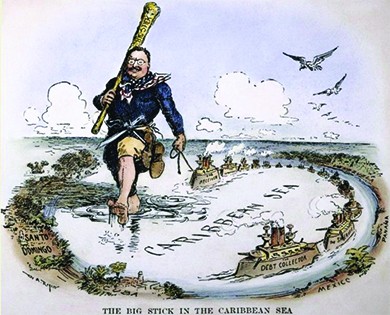
Roosevelt was ofttimes depicted in cartoons wielding his "large stick" and pushing the U.S. foreign calendar, oftentimes through the ability of the U.S. Navy.
Roosevelt believed that while the coercive ability wielded by the Usa could be harmful in the wrong hands, the Western Hemisphere'southward all-time interests were also the best interests of the United States. He felt, in brusque, that the United States had the correct and the obligation to be the policeman of the hemisphere. This belief, and his strategy of "speaking softly and carrying a big stick," shaped much of Roosevelt's foreign policy.
THE Structure OF THE PANAMA Culvert
As early as the mid-sixteenth century, interest in a canal beyond the Key American isthmus began to accept root, primarily out of trade interests. The subsequent discovery of gold in California in 1848 farther spurred involvement in connecting the Atlantic and Pacific Oceans, and led to the structure of the Panama Railway, which began operations in 1855. Several attempts past French republic to construct a culvert between 1881 and 1894 failed due to a combination of financial crises and health hazards, including malaria and xanthous fever, which led to the deaths of thousands of French workers.
Upon becoming president in 1901, Roosevelt was determined to succeed where others had failed. Post-obit the advice that Mahan gear up along in his book The Influence of Seapower upon History, he sought to achieve the structure of a canal beyond Central America, primarily for armed forces reasons associated with empire, but also for international trade considerations. The near strategic point for the construction was across the l-mile isthmus of Panama, which, at the plow of the century, was part of the nation of Republic of colombia. Roosevelt negotiated with the government of Colombia, sometimes threatening to accept the project away and build through Nicaragua, until Colombia agreed to a treaty that would grant the United States a lease on the country across Panama in exchange for a payment of $10 million and an boosted $250,000 annual rental fee. The affair was far from settled, however. The Colombian people were outraged over the loss of their land to the Usa, and saw the payment as far as well low. Influenced past the public outcry, the Colombian Senate rejected the treaty and informed Roosevelt there would be no culvert.
Undaunted, Roosevelt chose to now wield the "big stick." In comments to journalists, he made it clear that the United States would strongly support the Panamanian people should they choose to revolt against Colombia and form their ain nation. In November 1903, he even sent American battleships to the coast of Colombia, ostensibly for practice maneuvers, as the Panamanian revolution unfolded. The warships effectively blocked Colombia from moving additional troops into the region to quell the growing Panamanian insurgence. Inside a calendar week, Roosevelt immediately recognized the new land of Panama, welcoming them to the earth community and offering them the same terms—$x 1000000 plus the annual $250,000 rental fee—he had previously offered Colombia. Following the successful revolution, Panama became an American protectorate, and remained so until 1939.
In one case the Panamanian victory was secured, with American back up, structure on the canal began in May 1904. For the first yr of operations, the The states worked primarily to build acceptable housing, cafeterias, warehouses, auto shops, and other elements of infrastructure that previous French efforts had failed to consider. Nigh chiefly, the introduction of fumigation systems and musquito nets following Dr. Walter Reed's discovery of the office of mosquitoes in the spread of malaria and yellow fever reduced the death rate and restored the fledgling morale among workers and American-born supervisors. At the same time, a new wave of American engineers planned for the construction of the canal. Even though they decided to build a lock-arrangement rather than a sea-level canal, workers withal had to excavate over 170 1000000 cubic yards of world with the use of over one hundred new rail-mounted steam shovels. Excited by the work, Roosevelt became the start sitting U.Southward. president to go out the state while in office. He traveled to Panama where he visited the construction site, taking a turn at the steam shovel and removing dirt. The culvert opened in 1914, permanently changing world trade and military defense patterns.

Recurring landslides fabricated the earthworks of the Culebra Cut i of the most technically challenging elements in the construction of the Panama Culvert.
This timeline of the Panama Culvert illustrates the efforts involved in both the French and U.South. culvert projects.
THE ROOSEVELT COROLLARY
With the construction of the culvert now underway, Roosevelt next wanted to send a clear bulletin to the remainder of the world—and in detail to his European counterparts—that the colonization of the Western Hemisphere had at present concluded, and their interference in the countries there would no longer be tolerated. At the same time, he sent a message to his counterparts in Central and South America, should the Usa see issues erupt in the region, that it would intervene in order to maintain peace and stability throughout the hemisphere.
Roosevelt articulated this seeming double standard in a 1904 address before Congress, in a speech that became known as the Roosevelt Corollary. The Roosevelt Corollary was based on the original Monroe Doctrine of the early nineteenth century, which warned European nations of the consequences of their interference in the Caribbean. In this addition, Roosevelt states that the United States would use military force "as an international police power" to correct any "chronic wrongdoing" past whatever Latin American nation that might threaten stability in the region. Unlike the Monroe Doctrine, which proclaimed an American policy of noninterference with its neighbors' affairs, the Roosevelt Corollary loudly proclaimed the correct and obligation of the The states to involve itself whenever necessary.
Roosevelt immediately began to put the new corollary to work. He used information technology to plant protectorates over Cuba and Panama, equally well every bit to directly the United States to manage the Dominican Commonwealth's custom service revenues. Despite growing resentment from neighboring countries over American intervention in their internal affairs, every bit well as European concerns from distant, knowledge of Roosevelt'south previous actions in Colombia concerning acquisition of land upon which to build the Panama Canal left many fearful of American reprisals should they resist. Eventually, Presidents Herbert Hoover and Franklin Roosevelt softened American rhetoric regarding U.Due south. domination of the Western Hemisphere, with the latter proclaiming a new "Good Neighbor Policy" that renounced American intervention in other nations' affairs. However, subsequent presidents would go along to reference aspects of the Roosevelt Corollary to justify American involvement in Republic of haiti, Nicaragua, and other nations throughout the twentieth century. The map below shows the widespread effects of Roosevelt's policies throughout Latin America.

From underwriting a revolution in Panama with the goal of edifice a culvert to putting troops in Cuba, Roosevelt vastly increased the U.S. impact in Latin America.
The Roosevelt Corollary and Its Touch
In 1904, Roosevelt put the United States in the role of the "police power" of the Western Hemisphere and prepare a class for the U.Due south. relationship with Central and Latin America that played out over the adjacent several decades. He did so with the Roosevelt Corollary, in which he stated:
Information technology is not true that the U.s. feels any land hunger or entertains any projects every bit regards the other nations of the Western Hemisphere relieve as such are for their welfare. All that this state desires is to see the neighboring countries stable, orderly, and prosperous. Any country whose people conduct themselves well tin can count upon our hearty friendship. . . . Chronic wrongdoing, or an impotence which results in a general loosening of the ties of civilized lodge, may in America, as elsewhere, crave intervention by some civilized nation, and in the Western Hemisphere the adherence of the United states to the Monroe Doctrine may force the United states, however, reluctantly, in flagrant cases of such wrongdoing or impotence, to the exercise of an international law power."
In the twenty years later on he fabricated this statement, the U.s.a. would use military forcefulness in Latin America over a dozen times. The Roosevelt Corollary was used as a rationale for American involvement in the Dominican Republic, Nicaragua, Republic of haiti, and other Latin American countries, straining relations betwixt Central America and its ascendant neighbor to the north throughout the twentieth century.
AMERICAN INTERVENTION IN THE RUSSO-JAPANESE WAR
Although he supported the Open Door notes as an excellent economic policy in China, Roosevelt lamented the fact that the Usa had no strong military presence in the region to enforce it. Clearly, without a war machine presence there, he could non every bit hands use his "big stick" threat credibly to accomplish his foreign policy goals. Every bit a upshot, when conflicts did arise on the other side of the Pacific, Roosevelt adopted a policy of maintaining a balance of power among the nations there. This was particularly evident when the Russo-Japanese War erupted in 1904.

Japan's defence confronting Russia was supported by President Roosevelt, but when Japan'due south ongoing victories put the United States' own Asian interests at risk, he stepped in.
In 1904, angered past the massing of Russian troops along the Manchurian border, and the threat it represented to the region, Japan launched a surprise naval set on upon the Russian fleet. Initially, Roosevelt supported the Japanese position. All the same, when the Japanese fleet chop-chop achieved victory afterwards victory, Roosevelt grew concerned over the growth of Japanese influence in the region and the continued threat that it represented to People's republic of china and American admission to those markets. Wishing to maintain the aforementioned rest of power, in 1905, Roosevelt arranged for diplomats from both nations to attend a clandestine peace briefing in Portsmouth, New Hampshire. The resultant negotiations secured peace in the region, with Japan gaining command over Korea, several erstwhile Russian bases in Manchuria, and the southern half of Sakhalin Island. These negotiations also garnered the Nobel Peace Prize for Roosevelt, the first American to receive the honor.
When Japan later on exercised its authorization over its gains past forcing American business concern interests out of Manchuria in 1906–1907, Roosevelt felt he needed to invoke his "big stick" foreign policy, even though the distance was great. He did so by sending the U.South. Great White Armada on maneuvers in the western Pacific Ocean as a testify of force from December 1907 through Feb 1909. Publicly described every bit a goodwill tour, the bulletin to the Japanese regime regarding American interests was every bit articulate. Subsequent negotiations reinforced the Open up Door policy throughout China and the rest of Asia. Roosevelt had, by both the judicious use of the "big stick" and his strategy of maintaining a rest of ability, kept U.S. interests in Asia well protected.
Scan the Smithsonian National Portrait Gallery to follow Theodore Roosevelt from Rough Rider to president and beyond.
Section Summary
When Roosevelt succeeded McKinley as president, he implemented a key strategy for building an American empire: the threat, rather than the outright utilise, of military strength. McKinley had engaged the U.South. military in several successful skirmishes and so used the land'south superior industrial ability to negotiate beneficial strange trade agreements. Roosevelt, with his "big stick" policy, was able to go along the United States out of military conflicts by employing the legitimate threat of force. Notwithstanding, as negotiations with Japan illustrated, the maintenance of an empire was fraught with complexity. Irresolute alliances, shifting economic needs, and power politics all meant that the Usa would need to tread advisedly to maintain its status as a world ability.
Review Question
- Compare Roosevelt's foreign policy in Latin America and Asia. Why did he employ these different methods?
Review Question
- Roosevelt's strategy of "speaking softly and carrying a big stick" worked well in Latin America, where the United States had a strong armed forces presence and could quickly and easily human activity on whatever threat of military machine action. Roosevelt's threat of force was therefore credible in that region, and he was able to wield it effectively. In Asia, however, the United States had less of a war machine presence. Instead, Roosevelt sought to maintain a remainder of power, wherein the various Asian countries kept each other in check and no unmarried role player grew too powerful. When the power rest tipped, Roosevelt acted to broker a peace deal between Russia and Japan every bit a means of restoring rest.
Glossary
Roosevelt Corollarya argument by Theodore Roosevelt that the United States would employ military force to deed as an international police force power and right any chronic wrongdoing past whatever Latin American nation threatening the stability of the region
daveyfingrifuread.blogspot.com
Source: https://courses.lumenlearning.com/suny-ushistory2os2xmaster/chapter/roosevelts-big-stick-foreign-policy/
0 Response to "Review the Detail Roosevelt Explains That One of His Reasons"
Post a Comment